





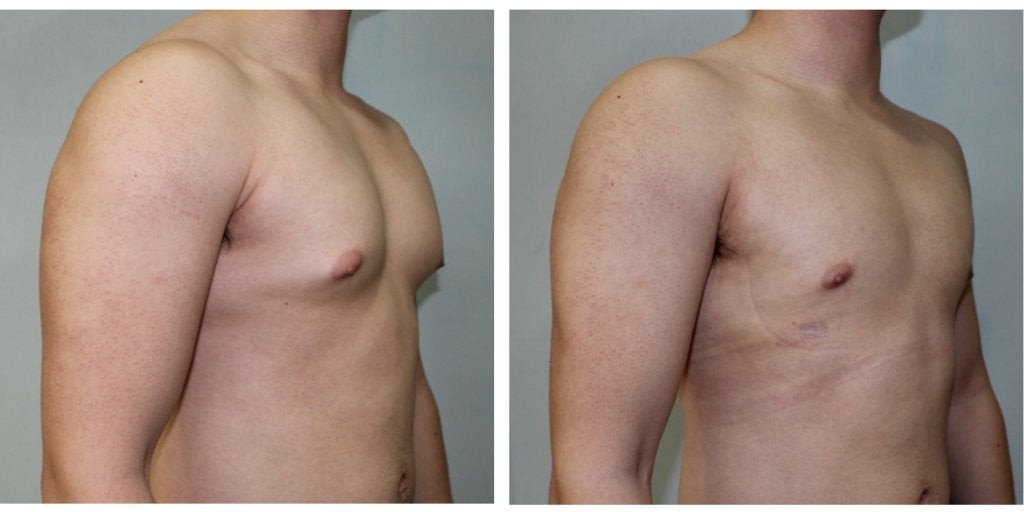
Gynaecomastia is a condition of excessive breast tissue growth in men. This can be related to a hormonal imbalance, genetic predisposition, medication use, or the proliferation of fatty tissue. The surgery is primarily for aesthetic purposes and restores the contour of the chest.
Who is suitable for the procedure?
• Men who are concerned about breast enlargement
• Patients who have not responded to hormonal or medical treatment
• Anyone in good health who is suitable for surgery
Consultation
Before deciding on gynaecomastia surgery, your doctor will examine your chest area and determine the type of gynaecomastia you have. At this stage, it is established whether the breast development is caused by a build-up of fat or an increase in glandular tissue.
If the problem stems from enlarged mammary gland tissue, this tissue is surgically removed. This usually involves making a small incision along the areola (the coloured area around the nipple), which allows the scar to be concealed and makes it less noticeable.
If the breast enlargement is solely related to an excess of fat, the surgeon removes the fat using liposuction with no incisions or with very small entry points.
In cases where the breasts are excessively large, however, fat removal alone is not sufficient. If there is excess sagging skin, a skin tightening procedure may also be added to the operation.
Recovery process:
• Mild pain, swelling and bruising for a few days after the operation are normal.
• The prescribed corset must be worn for 1 month.
• Strenuous physical activity and sports are restricted for 4–6 weeks
• Patients can return to their daily activities 1 week after the operation
• The results are usually fully visible 3 months after the operation
How is the operation performed?
Gynecomastia surgery can be performed under intravenous sedation or general anaesthesia. The choice is determined by the surgeon, taking into account the patient's age, the amount of breast tissue, and the complexity of the procedure.
The operation takes approximately one hour. After the procedure, patients are usually discharged home on the same evening or the following day and can continue to rest comfortably.